You likely already know that a poorly chosen fabric can ruin even the sharpest cut. We see this constantly at LANWIN Premier, a family-owned legacy menswear business established in 1979 by Grand Master Desmond Loi and now led by third-generation Master Tailors. This is especially true in Kuala Lumpur, where average daily highs routinely hit 32°C (90°F) alongside a punishing 86% average humidity.
Such extreme heat means heavy European cloths will trap heat instantly. Our team has spent decades analyzing how different cloths react to sustained humidity. This difference is why selecting the right cloth for your daily professional wardrobe is the most critical decision you will make.
Let us examine the data behind fabric performance and outline the specific characteristics that make certain materials work in our environment.
Understanding Fabric Weight
Fabric weight is measured in grams per metre (g/m) or ounces per yard (oz/yd). Our tropical climate demands a considerably narrower range than what European styling guides recommend. Weather data for 2025 shows that Kuala Lumpur maintains a relative humidity between 73% and 86% year-round.
This constant moisture requires specific fabric choices. We generally advise clients to ignore anything above 280 g/m for local daily wear. The sweet spot for most Malaysian gentlemen sits squarely between 200 and 250 g/m.
This specific range remains light enough to keep you comfortable during the walk from your car to the office, yet substantial enough to drape properly.
Weight Classifications for Malaysia
| Classification | Weight Range | Best Application |
|---|---|---|
| Lightweight | 190-230 g/m | Ideal for daily wear. Breathes well and resists heat retention. |
| Mid-weight | 240-280 g/m | Suitable for air-conditioned corporate environments. |
| Heavyweight | 290+ g/m | Unsuitable for Malaysian conditions. Avoid for local wear. |
Wool: The Undisputed Foundation
Despite common misconceptions, wool is not strictly a cold-weather material. It is actually one of the most versatile natural fibres on earth.
The secret to its cooling properties lies in the weave, the weight, and the quality of the fibre itself.
Tropical Worsted Wool
Tropical worsted wool is woven from tightly twisted yarns in an open weave that allows air to circulate freely. This structure feels cool against the skin and maintains a crisp appearance throughout a long day in court or the boardroom.
We frequently recommend this material for Malaysian corporate executives. The finest options come from Dormeuil, Scabal, and Loro Piana, houses that engineer specific collections for warm climates.
Loro Piana’s Zelander Dream collection offers an exceptional 230 g/m tropical wool that provides incredible breathability and an ultra-luxurious, smooth finish.
High-Twist Wool
High-twist fabrics use yarns that are twisted more aggressively during the spinning process. This aggressive twist creates a springy, resilient cloth that resists creasing remarkably well.
Our team finds this wrinkle resistance highly advantageous in our humid climate, where standard fabrics often look dishevelled by midday. Dormeuil’s iconic Tonik Wool is a prime example of this engineering.
The modern Tonik range utilizes Patagonian wool in a 295 g/m high-twist weave to deliver natural stretch and crease-free performance without relying on synthetic blends. These cloths have a slightly textured surface that adds visual interest, making them excellent for travel and for gentlemen moving constantly between air-conditioned offices and outdoor humidity.
Fresco and Crispaire
These are specialised open-weave wools developed specifically for maximum airflow. Fresco, originally created by the English mill Martin Sons & Co., features a highly porous weave.
The trade-off is slightly less structure than a standard worsted, but the ventilation gains in tropical conditions are substantial. Crispaire offers a similar concept with a slightly tighter weave, serving as an excellent middle ground.
Wool-Mohair Blends: The Tropical Specialist
If tropical worsted wool is the reliable all-rounder, wool-mohair blends are the precision-engineered option for extreme heat. Mohair is sourced from the Angora goat and brings several unique properties to professional garments.
Why Mohair Works
Textile experts often refer to mohair as the “diamond fiber” due to its incredible strength and natural sheen. Its tensile strength is comparable to steel of the same diameter, making it exceptionally durable for daily wear.
We favour this material because its smooth fibres resist dust and moisture naturally. Mohair is also highly elastic, stretching up to 30% and springing back to shape without wrinkling.
A garment in a 70/30 wool-mohair blend will maintain its sharp lines from morning to evening. The fabric dries quickly if dampened by a brief downpour and retains its shape with minimal maintenance.
Ideal Mohair Ratios
Here are the most common configurations:
- 90/10 wool-mohair: Subtle lustre enhancement with minimal change to the wool’s handle.
- 70/30 wool-mohair: The most popular blend for corporate wear. Noticeable lustre and improved wrinkle resistance.
- 50/50 wool-mohair: Maximum lustre and resilience. The fabric can feel slightly stiffer.
For custom commissioned garments intended for daily corporate wear in Malaysia, a 70/30 blend in the 210-240 g/m range consistently performs the best.
Linen: Beautiful but Demanding
Linen occupies a unique position in tropical menswear. No natural fibre breathes better, and no fabric feels cooler against the skin.
The Linen Reality
Linen possesses exceptional moisture management properties. The fabric can actually absorb up to 20% of its weight in moisture before it even begins to feel damp.
Our experience shows that pure linen wrinkles almost immediately. Within an hour of wearing it, you will develop creases at the elbows, across the back, and behind the knees.
Some grooms embrace this relaxed aesthetic for a beach wedding at Pantai Cenang in Langkawi, while corporate executives often find it unacceptable for the boardroom.
Linen Blends
The solution for many clients lies in strategic linen blends.
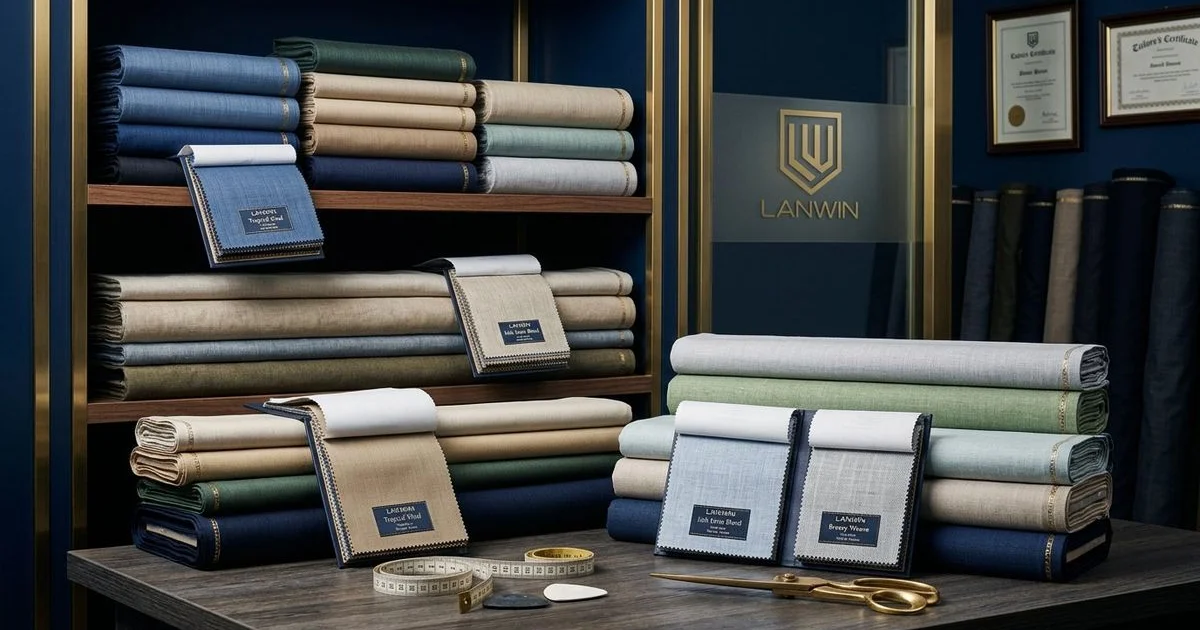
- Wool-linen (70/30 or 60/40): Retains much of linen’s breathability while gaining wool’s wrinkle resistance. Excellent for smart-casual occasions.
- Linen-silk: Adds a subtle sheen and improves drape. It can feel warm in direct sunlight.
- Linen-cotton: The most casual option. Best suited for unstructured jackets.
Reserve pure linen for weekend wear, garden parties, and outdoor events where a degree of relaxed rumpling is appropriate. For professional settings, choose a wool-linen blend that captures the comfort without the heavy maintenance demands.
Cotton: Versatile but Limited
Cotton suits have a firm place in casual and smart-casual settings. Cotton chinos and unstructured blazers work beautifully in Malaysia’s climate.
Cotton’s Limitations
Premium varieties like Pima or Sea Island cotton offer exceptional softness, but cotton lacks the natural resilience of wool. It wrinkles easily and stretches over the course of the day.
We note that cotton absorbs moisture rather than wicking it away. This characteristic can create visible perspiration marks, which is a major concern in high humidity.
Where Cotton Excels
Cotton performs admirably for unstructured weekend jackets and chino trousers. Cotton poplin shirts remain the absolute standard for business wear.
For structured daily professional wardrobe requirements, wool remains the superior choice.
Silk Blends: Luxury with Purpose
Silk creates fabrics of extraordinary refinement when blended with wool. A wool-silk blend captures silk’s lustrous drape and softness while retaining wool’s structure.
Wool-Silk Blends
A typical wool-silk blend (85/15 or 80/20) adds a subtle luminosity to the surface without the overt shine that might seem inappropriate in corporate settings. The silk component improves the drape and allows the jacket to flow more naturally.
For tuxedos and formal wear, a wool-silk blend in midnight blue or black creates a garment of exceptional beauty. The material catches light beautifully under the warm illumination of evening events at venues like The St. Regis Kuala Lumpur.
Silk Linen
This specific blend combines silk’s sheen with linen’s breathability. The result is a fabric that looks elegant and feels cool.
We recommend this option for daytime events, outdoor ceremonies, and smart-casual occasions where you wish to appear polished without looking overdressed.
Technical Fabrics: The Modern Option
Several premium mills now introduce technical fibres to enhance performance in warm climates. These modern innovations offer significant practical advantages for the travelling executive.
The LYCRA Company’s Coolmax EcoMade fibres, for example, are engineered specifically to wick moisture away from the body to the fabric surface for rapid evaporation.
- Wool with Lycra/Elastane: Adds stretch and recovery. Improves comfort during long seated meetings.
- Wool with Coolmax: Greatly enhances moisture-wicking properties for high-humidity environments.
- Loro Piana Storm System: Adds wind and water protection while retaining a natural appearance.
We suggest choosing pure natural fibres from established mills for your finest garments. For high-rotation corporate wear and travel, consider these technical blends that prioritize performance and arrive wrinkle-free after a transatlantic flight.
Fabric Selection by Occasion
To simplify the decision process, here is a practical framework based on our local experience:
| Occasion | Recommended Fabric | Weight Range |
|---|---|---|
| Daily corporate wear | Tropical worsted wool | 200-240 g/m |
| Important meetings | Super 120s-150s worsted | 210-250 g/m |
| Travel | High-twist wool or wool-Lycra | 220-260 g/m |
| Formal evening | Wool-silk blend or wool-mohair | 240-270 g/m |
| Smart-casual Friday | Wool-linen blend | 200-240 g/m |
| Weekend | Linen or cotton | 180-230 g/m |
The LANWIN Premier Fabric Experience
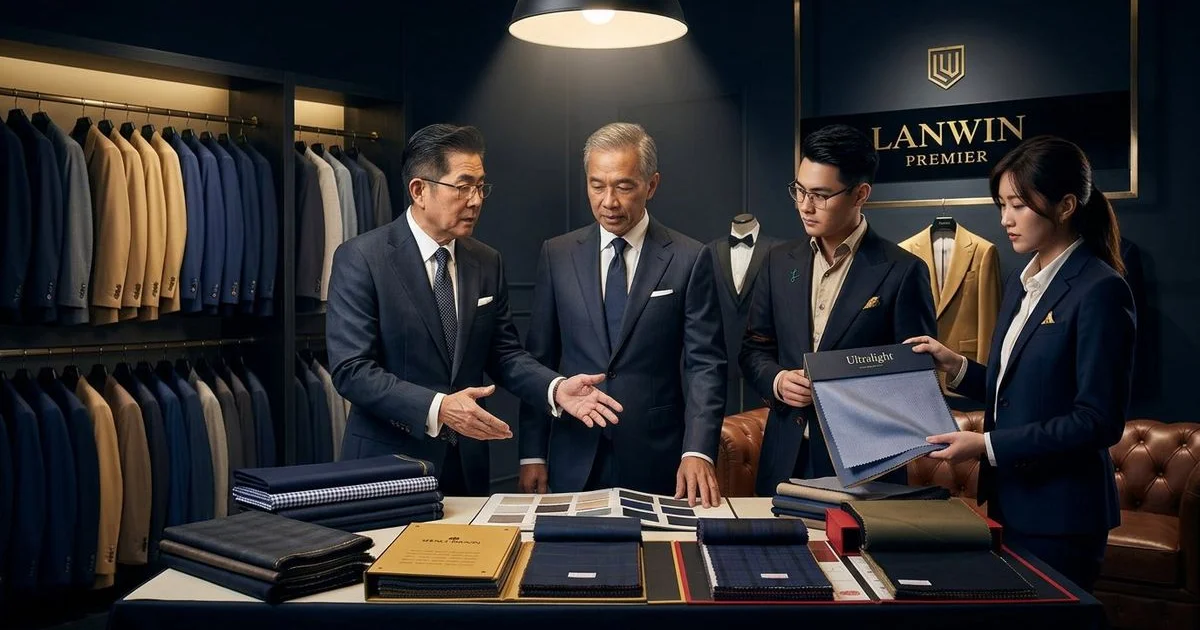
Fabric selection should never be rushed. We maintain one of the most extensive fabric libraries in Malaysia, with cloths sourced from the world’s finest mills.
When you visit for a custom suit consultation, you will see, touch, and drape each fabric. Understanding how a cloth behaves on the body is crucial before committing to a cut.
For our discreet executive clients, we bring a curated selection of fabrics directly to your home or office. These selections are chosen specifically based on your professional requirements and preferences.
Conclusion
Our decades of experience prove that investing in the right fabric always pays dividends. The cloth serves as the foundation upon which every great suit is built.
A proper fabric determines whether your garment serves you brilliantly or merely adequately in the Malaysian heat. Choose wisely to guarantee your attire rewards you with comfort, confidence, and absolute respect in every room you enter.
Schedule a consultation with our Master Tailors today to discover the perfect fabric for your next commission.